


PGM market volatility can quickly change the value of your catalytic converter inventory.
Platinum scrap metal may rise while palladium weakens. Rhodium can move sharply in either direction. For collectors and traders, the challenge is not simply deciding when to sell.
It is also knowing:
- how much to pay when collecting;
- how much inventory to hold;
- when to recycle;
- when assay-based settlement makes sense; and
- when to hedge your PGM exposure.
The goal should not be to predict every market move. The goal is to protect your margin and keep your capital working.
Buy With a Margin
Your recycling profit starts when you buy the material.
During a rising market, it is easy to become more aggressive with purchasing prices. But higher PGM prices do not automatically mean you should pay more.
Before buying, work backwards:
Estimated recycling value − target margin − relevant costs = maximum buying price
Always leave enough room for market movements between collection and settlement.
Ask yourself: If PGM prices fall tomorrow, does this purchase still make commercial sense?
Refer here: catalytic converter price apps are useful as references, but today’s quoted value does not guarantee profit if you settle tomorrow.
Know What You Are Collecting
Good inventory records become even more important when markets are volatile.
Where possible, record:
- converter code
- purchase price
- purchase date
- supplier
- quantity
- converter type or condition.
Without knowing what you paid, it is difficult to know whether today’s selling price actually gives you a good margin.
For bulk collectors, inventory should be managed as a business asset, and not simply as a pile of converters waiting for prices to rise.
Do Not Punt or Hold Inventory Indefinitely
A rising market often creates the temptation to keep waiting.
You probably think, “Prices are rising. Maybe I should hold another week.”
Then another week becomes another month. Meanwhile, your working capital remains tied up.
A better approach is to establish clear selling triggers. For example:
- the lot reaches an efficient processing volume (usually about 300 kg and above)
- your target margin is achieved
- inventory reaches a predetermined limit
- you need to release working capital for new purchases.
This prevents your collection strategy from becoming an unintended bet on future PGM prices.
Focus on Inventory Turnover, Not Just Metal Prices
A higher selling price does not always mean a better business result. Imagine you hold a lot for two extra months hoping for a 5% increase in PGM prices.
During those two months, the money tied up in that inventory cannot be fully used to buy more material.
For a high-volume collector, faster inventory turnover can sometimes be more valuable than waiting for the highest possible price.
It’s better to consider Margin × Inventory Turnover rather than focusing only on PGM Price
The objective is not necessarily to maximise the profit from one lot. It is to keep generating profitable buying and recycling cycles.
Consider Assay-Based Recycling for Bulk Lots
As collection volumes increase, your recycling strategy may also need to change.
Small quantities are often traded using per-piece pricing.
For suitable bulk lots, value-based settlement provides another option.
The material is processed, homogenised, sampled and analysed to determine its actual PGM content.
BR Metals’ value-based recycling process includes:
Decanning → Milling → Homogenisation → Representative Sampling → XRF Analysis → ICP Analysis → Settlement
This changes the conversation from, “What is each converter worth?” to “How much platinum, palladium and rhodium does my processed material contain?”
For bulk collectors, accurate sampling and assay can be just as important as the metal price.
Read this article to understand more about: Bulk Recycling (Settlement by Assay) VS. Selling by Piece
Understand That Platinum and Palladium May Move Differently
Understand that there is no single “PGM market”.
Platinum, palladium and rhodium have different supply-and-demand fundamentals.
Recent market outlooks illustrate this clearly. The World Platinum Investment Council expects platinum deficits to continue through 2030, while palladium is forecast to move towards surplus from 2027.
Singapore’s business news daily, The Business Times has also highlighted the sharp movements seen in platinum and palladium and how relatively thin PGM markets can experience significant price swings.
However, these are forecasts, not guarantees.
For catalytic converter collectors, the practical takeaway is simple – Do not build your buying or selling strategy around the assumption that all PGM prices will move in the same direction.
Refer here to understand more about who buys platinum, palladium and rhodium during this market demand.
Sell When the Margin Works for You
Trying to identify the exact top of the PGM market is extremely difficult. Instead, establish your target margin before making the selling decision.
Ask, “What did I pay?”, “What is the current value?”, “Does today’s return meet my target?” If it does, you then have to decide whether to protect that return or continue holding in the hope of further upside.
Waiting may increase your profit. It may also reduce it. The important thing is that the decision is deliberate.
Use Hedging to Manage Price Risk
PGM hedging can help bulk suppliers reduce exposure to changes in platinum, palladium and rhodium prices
It is not about predicting whether prices will rise or fall. It is about managing uncertainty.
If current prices already provide an acceptable margin, hedging may allow you to protect more of that value rather than leaving the entire transaction exposed to future market movements.
BR Metals offers PGM hedging for qualifying materials and transactions under its value-based recycling model.
Hedging is about protecting an acceptable margin. It is not chasing the highest possible market price.
A Simple Strategy for Bulk Catalytic Converter Collector
During volatile markets, keep your strategy simple:
- Buy carefully.
- Know the estimated value and maintain your purchasing margin.
- Track your costs.
- Know exactly what you paid for your inventory.
- Build efficient lots.
- Accumulate enough material for efficient recycling without holding indefinitely
- Know your PGM content.
- For suitable bulk lots, consider representative sampling and assay-based settlement.
- Set a target margin.
- Decide what return is acceptable before emotions take over.
- Do not let inventory unnecessarily restrict your ability to keep buying.
- Manage price risk.
- Consider hedging when an acceptable return is available.
Optimising Recycling Value in a Volatile Market
Successful bulk catalytic converter recycling is not simply about finding the highest PGM price.
It is about managing the entire cycle:
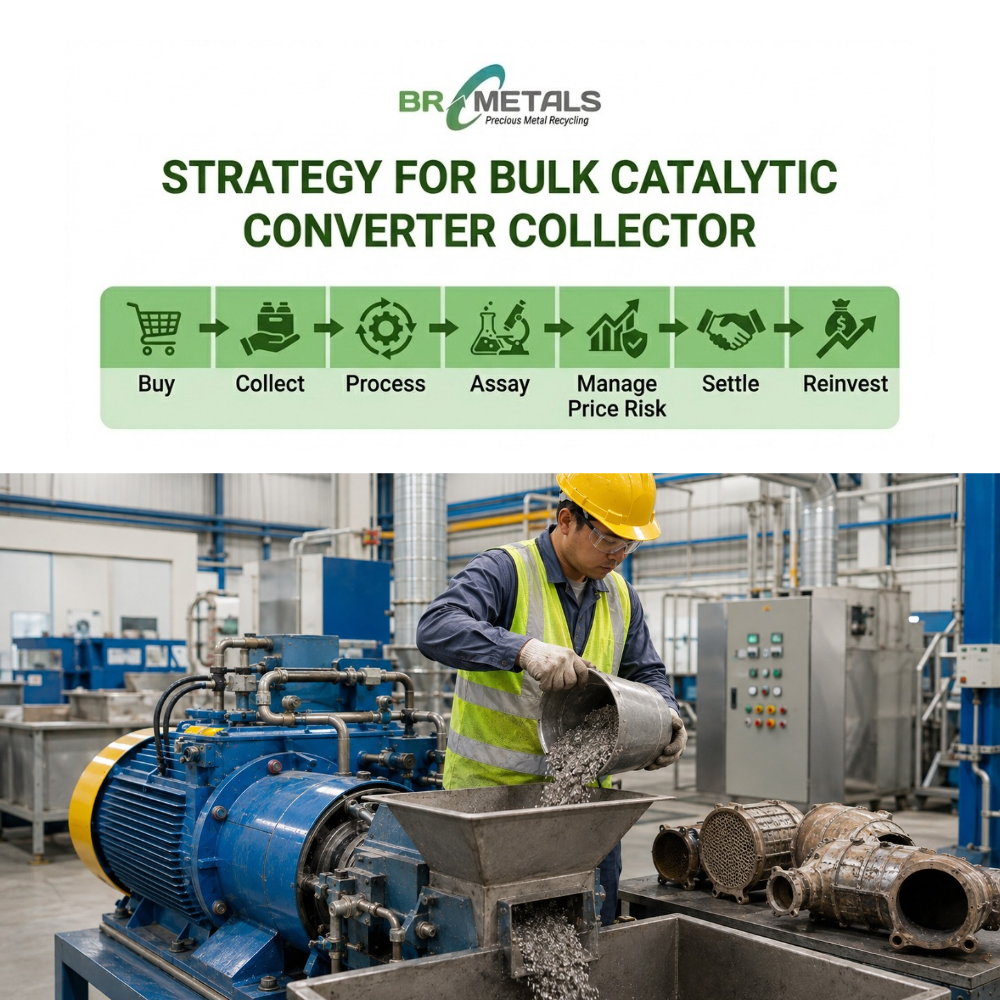
Buy → Collect → Process → Assay → Manage Price Risk → Settle → Reinvest
At BR Metals, our value-based recycling model combines professional processing, representative sampling, XRF and ICP analysis, precious metals recycling and PGM hedging to help qualifying bulk suppliers better manage their recycling returns.
If you are collecting catalytic converters in volume, the question is not only:
“Where will PGM prices go next?” A better question is, “How can I protect my margin while keeping my capital moving?”
Talk to BR Metals About Your Bulk Catalytic Converter Strategy
Speak with BR Metals as a precious metal recycler companies about:
- bulk catalytic converter recycling;
- value-based settlement;
- sampling and assay;
- PGM hedging; and
- recycling strategies for volatile markets.
You cannot control PGM prices. But you can control how you buy, how long you hold, how accurately your material is valued and how much market risk you take.
FAQ
Focus on purchasing margin, accurate inventory records, efficient turnover, appropriate lot sizes and reliable sampling and assay. For qualifying transactions, hedging can also help manage PGM price exposure.
Not automatically. Holding may provide additional upside, but it also ties up working capital and leaves your inventory exposed if prices reverse.
Consider selling when the lot is commercially efficient to process, your target margin has been reached or holding the inventory is restricting working capital.
Assay-based settlement determines the PGM content of processed bulk material through representative sampling and laboratory analysis, providing a value based on the analysed material.
BR Metals offers PGM hedging for qualifying materials and transactions. Hedging is designed to manage price risk and does not guarantee the highest market price or a particular profit.
PGM market forecasts can change. Hedging is a risk-management strategy and does not guarantee a particular metal price, profit or recycling return.