


You have accumulated a sizeable lot of spent catalytic converters or other PGM scrap for recycling.
Platinum, palladium and rhodium prices are moving, and you are wondering:
Should I sell now, or wait for prices to go higher?
There is no perfect answer because no one can predict the exact top of the PGM market.
A better approach is to ask:
Does today’s price give me an acceptable margin?
If the answer is yes, you can consider selling and using PGM hedging to reduce the risk of prices falling before settlement.
In other words, instead of trying to predict the highest possible price, focus on protecting a profitable price when it becomes available.
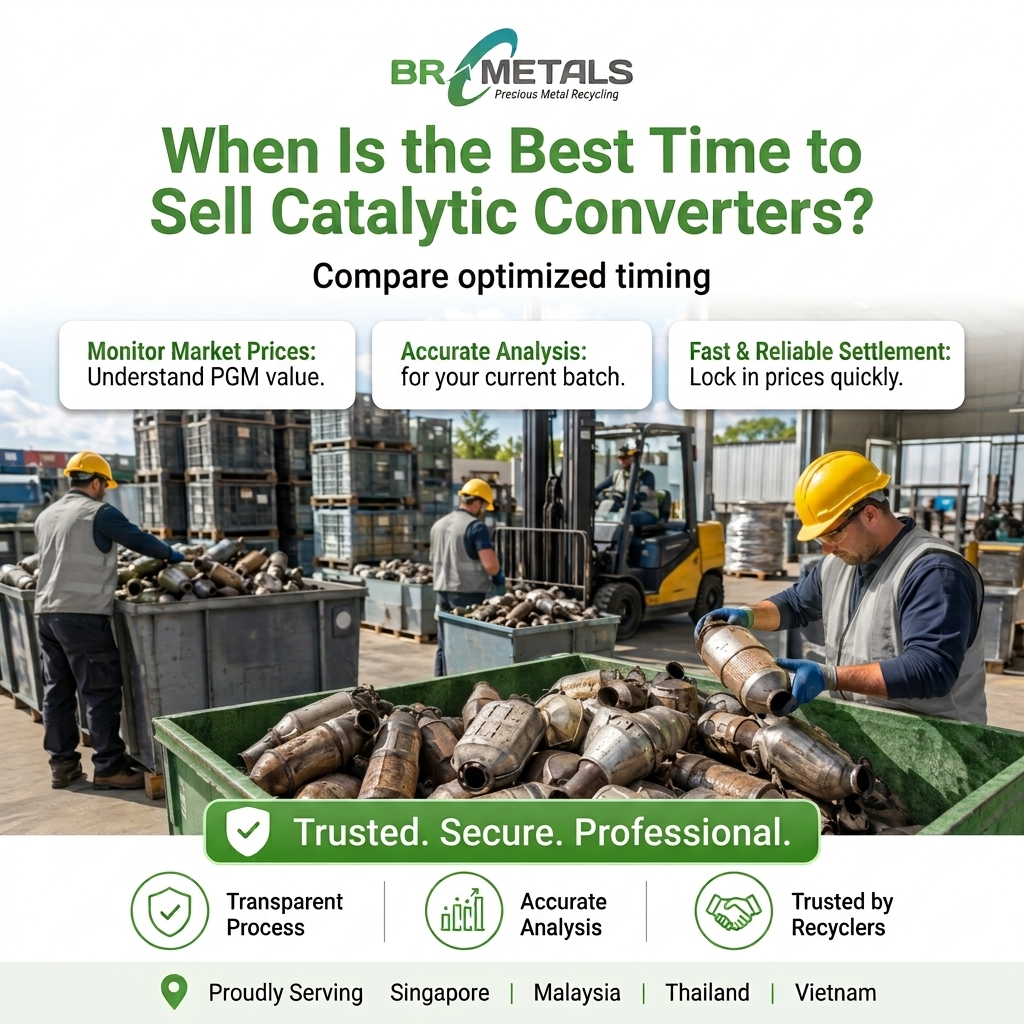
When Is the Best Time to Sell Catalytic Converters?
There is no universal best day or best month to sell spent catalytic converters.
The right time depends on your own business. For most professional collectors and traders, three questions are more useful than trying to predict the market:
- What did I pay for the material?
- What margin can I achieve at today’s PGM prices?
- Am I comfortable with the risk of prices changing while I continue to hold the material?
If today’s value already gives you the return you want, waiting for a higher price also means accepting the possibility of a lower one.
That is where hedging can help.
What Is PGM Hedging?
PGM hedging is a way to manage your exposure to changes in platinum, palladium and rhodium prices.
It is not about predicting whether prices will rise or fall. It is about reducing uncertainty.
For example, you buy a lot of spent catalytic converters. PGM prices rise and the lot now gives you a satisfactory profit margin.
You could keep holding the material and hope prices rise further. Or you could use an available hedging arrangement to protect the metal value based on agreed terms.
If prices later fall, you have reduced your exposure to that decline. If prices rise further, you may not receive the additional upside on the portion already fixed.
That is the trade-off.
Hedging is about protecting an acceptable margin, not chasing the highest possible market price.
BR Metals offers PGM hedging as part of its value-based recycling services for qualifying materials and transactions.
4 Signs It May Be a Good Time to Sell
Your Target Margin Has Already Been Reached
Start with your numbers.
If you know your purchasing cost and today’s metal value already gives you a healthy margin, ask whether it is worth risking that margin for the possibility of a slightly higher price.
For example, if the return available today meets your target, you already have a profitable transaction.
Waiting may increase that profit. But it may also reduce it.
The decision becomes much easier when you set your target margin before deciding whether to sell.
Once your target is reached, protecting it can be more important than trying to squeeze out the last few percentage points.
Too Much Money Is Tied Up in Inventory
Every catalytic converter sitting in your warehouse represents money you have already spent.
Until that material is sold and settled, that capital may not be available to buy more stock.
For high-volume collectors and traders, this matters.
Instead of asking only, “Can I get a higher price next month?” also ask, “Could I use this money to buy another profitable lot today?”
Sometimes turning your inventory faster can be more valuable to the business than waiting for a small increase in PGM prices.
This is why selling decisions should consider cash flow and inventory turnover, not just metal prices.
PGM Prices Have Moved in Your Favour
When prices rise, it is natural to want more.
You may think: “Maybe I should wait another week.”
But the market can move in either direction. If today’s price already gives you the margin you want, hedging can help you protect more of that value instead of leaving the entire position exposed to future price movements.
Hence, the important question is not: “Will prices go higher?”
It is: “Am I satisfied with the return available now?”
Read more about this article on how PGM prices can rise based on the economic situation: Middle East War Impact on Catalytic Converter Scrap Prices
You Are Holding Simply Because You Hope Prices Will Rise
There can be good reasons to hold catalytic converters.
You may be building a larger processing lot, arranging logistics or waiting for material to be ready for settlement.
But if the only reason is: “I think PGM prices might go higher,” then part of your recycling business has effectively become a punt on future metal prices.
That may be a risk you are willing to take but it should be a deliberate decision.
If you would prefer more certainty, hedging may be worth considering.
Platinum, Palladium and Rhodium Do Not Always Move Together
Another reason market timing is difficult is that there is no single “PGM price”.
Palladium, rhodium and platinum metal recycling have their own supply-and-demand conditions.
One may be rising while another is falling.
That matters because a spent catalytic converter contains a combination of these metals.
So even if you believe platinum prices will rise, the value of your complete lot may also be affected by what happens to palladium and rhodium.
This is why simply saying “PGM prices are going up” may not give you enough information to make a selling decision.
Knowing the PGM Content Matters Too
Metal price is only one part of the equation.
You also need to know how much platinum, palladium and rhodium is actually in your material?
For qualifying bulk lots, BR Metals uses a value-based recycling process that includes:
Decanning → Milling → Homogenisation → Representative Sampling → XRF Analysis → ICP Analysis → Settlement
This helps determine the PGM content of the processed material.
Put simply – assay tells you how much metal you have while hedging helps you manage the price risk on that metal.
Both are important when deciding whether it is the right time to sell.
The Cost of Waiting for Higher PGM Prices
Waiting is not free. When you hold material, your working capital remains tied up.
Imagine you have $100,000 worth of inventory.
You decide to wait because you expect PGM prices to rise.
During that time, the $100,000 remains tied up in your existing stock rather than being used to buy more material.
If prices rise, waiting may work in your favour.
But if prices fall – or remain unchanged – you may have delayed both your settlement and your next purchasing cycle.
That is why professional scrap businesses should look beyond the price of a single lot.
You can refer to these pages to learn more about current market trends by installing our apps: catalytic converter scrap price
You should consider the following too:
- profit margin;
- working capital;
- inventory turnover;
- cash flow;
- price risk.
The goal is not always to make the maximum possible profit from one batch.
Rather, your goal is to build a profitable business that can continue buying and turning material.
The Real Question Is Not “When Will PGM Prices Peak?”
For professional catalytic converter collectors and PGM scrap suppliers, trying to identify the exact top of the platinum, palladium or rhodium market can easily distract from the economics that matter most.
What did you pay for the material?
What does the assay show?
What margin can you achieve?
How much capital is tied up?
And how much price risk are you willing to carry?
That is where the selling decision should begin.
At BR Metals, our value-based recycling model combines professional processing, representative sampling, XRF and ICP analysis, precious-metals management and PGM hedging to help qualifying bulk suppliers gain greater visibility over their recycling returns and manage exposure to volatile metal prices.
So, if you are currently holding spent catalytic converters or other PGM scrap because you are waiting for the “perfect” price, consider asking a different question: If today’s value already gives me the margin I want, how much of that margin am I prepared to risk waiting for more?
Talk to BR Metals About Your PGM Scrap Recycling
If you have a qualifying lot of spent catalytic converters or other PGM-bearing scrap, speak with BR Metals, a precious metal recycling company, about your recycling, assay, settlement and hedging options.
You cannot control where PGM prices go next. But you can control how much price risk your business takes.
Hedging is a risk-management strategy and does not guarantee a particular price, profit or recycling return. Terms and eligibility vary by transaction.
FAQ
Before deciding whether to sell your spent catalytic converters or other PGM scrap, ask yourself:
- What did I pay for the material? Know your purchasing cost.
- What return can I achieve today? Calculate the value based on the current market and your expected settlement.
- Does that return meet my target margin? If yes, decide whether the potential extra upside is worth the additional risk.
- How much working capital is tied up? Consider what else that money could be doing for your business.
- What happens if PGM prices fall? Do not look only at the potential upside.
- Can hedging help me reduce that risk? If an appropriate hedging arrangement is available, consider whether greater price certainty supports your business objectives.
There is no universal best time for every seller.
A more useful approach is to determine whether today’s valuation produces an acceptable return based on your acquisition cost, PGM content, required margin and working-capital needs.
If it does, consider whether protecting that return is more important to your business than remaining exposed to future PGM price movements.
You can but waiting means accepting continued exposure to metal-price movements.
Current market outlooks also illustrate why this is difficult: platinum, palladium and rhodium do not share identical market fundamentals. WPIC currently forecasts a platinum deficit in 2026, while Heraeus’ outlook for palladium and rhodium is different.
There is therefore no simple “PGMs are going up” decision that applies to every lot.
For value-based settlement, the recoverable platinum, palladium and rhodium content is determined through processing, representative sampling and analysis, while the applicable metal prices and settlement terms determine the financial valuation of those contained metals.
BR Metals uses XRF and ICP analysis as part of its PGM valuation process.
The principal advantage is risk management.
Hedging can help reduce exposure to adverse price movements and provide greater visibility over the economics of a transaction.
It DOES NOT guarantee the highest possible market price.
Yes. BR Metals states that it provides hedging of metals as part of its value-added services and that qualifying value-based settlement customers can hedge platinum, palladium and rhodium recovered from their material.
Eligibility, timing and settlement conditions should be confirmed for each transaction.
Market information and forecasts are provided for general informational purposes. Hedging is a risk-management strategy and does not guarantee a particular price, profit or recycling return. Applicable hedging arrangements and settlement terms vary by transaction.