


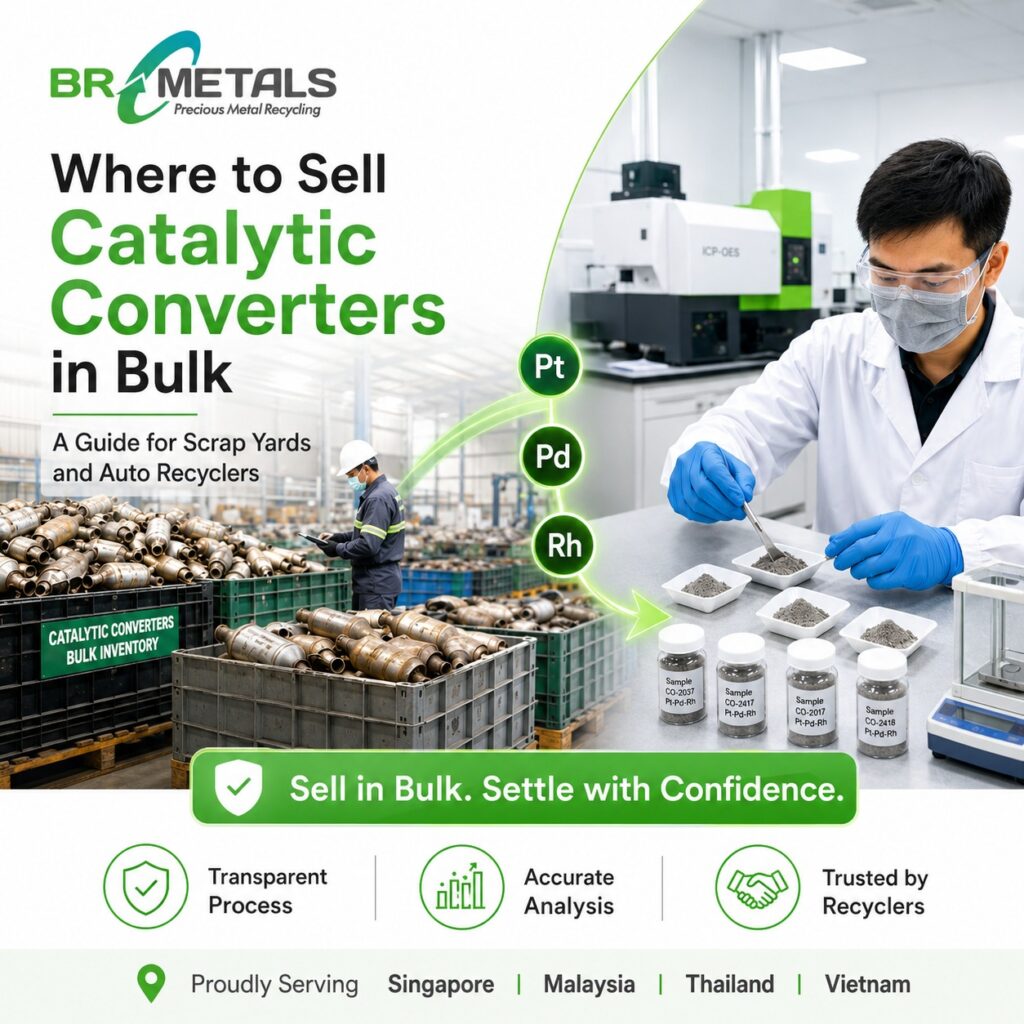
When a spent catalytic converter is sold, its value does not end at the scrapyard.
Inside every catalytic converter is a small but highly valuable concentration of Platinum Group Metals, commonly known as PGMs. The three most important metals recovered from catalytic converters are platinum, palladium and rhodium. These metals are used because of their powerful catalytic properties, helping vehicles reduce harmful exhaust emissions.
But once these metals are recovered, where do they actually go?
Who buys platinum, palladium and rhodium after they are extracted from catalytic converters?
The answer is not just “scrap buyers” or “refineries.” The PGM recycling market is a global supply chain involving collectors, processors, assayers, refiners, metal traders, industrial manufacturers, automotive suppliers and specialist end-users.
For bulk catalytic converter sellers, understanding this market can help you make better decisions about who to sell to, how your materials are valued, and why accurate sampling and assay matter so much.
What are Platinum, Palladium and Rhodium Used For?
Platinum, palladium and rhodium are part of the Platinum Group Metals family. They are rare, durable, highly resistant to corrosion and valued for their catalytic properties.
In catalytic converters, these metals help convert harmful gases from internal combustion engines into less harmful emissions. Platinum and palladium help oxidise carbon monoxide and hydrocarbons, while rhodium plays an important role in reducing nitrogen oxides.
However, automotive catalysts are not the only market for PGMs. Once recovered and refined, these metals can be reused in a wide range of industries, including:
- Automotive emissions control systems
- Chemical and petrochemical catalysts
- Glass and fibreglass manufacturing
- Electronics and electrical components
- Hydrogen and fuel cell technologies
- Medical devices and pharmaceutical applications
- Jewellery and investment products
This broad demand is what makes catalytic converter recycling commercially important. Spent catalytic converters are not just scrap. They are a secondary source of critical precious metals.
Who Buys Recovered Platinum, Palladium and Rhodium?
The buyers of recovered PGMs depend on the form of the material.
A bulk seller may sell whole catalytic converters, decanned ceramic, powder or other PGM-bearing materials. But industrial end-users usually do not buy mixed catalytic converter scrap directly. They typically require refined metal, sponge, ingots, salts, solutions, alloys or other specialised forms that meet strict purity and quality standards.
This is where platinum group metals (PGM) recovery companies in Singapore and across Southeast Asia play a key role.
- Catalytic Converter Recycling Companies
The first major buyer in the chain is the catalytic converter recycling company.
These companies buy spent catalytic converters from workshops, scrap yards, vehicle dismantlers, aggregators, traders and other bulk sellers. Their role is to process the material, recover the value of the PGMs and connect that material to the next stage of the supply chain.
A professional catalytic converter recycler does more than simply offer a price per piece. For bulk lots, the recycler should be able to process, sample, analyse and settle the material based on its actual precious metal content.
This is especially important because two catalytic converters that look similar may not contain the same amount of platinum, palladium or rhodium. Precious metal content can vary depending on vehicle model, production year, country of origin, emission standard, engine type and the condition of the material.
For bulk sellers, working with a recycler that offers reliable transparent sampling and accurate assay can make a significant difference to returns.
- PGM Refineries
After catalytic converters are processed and sampled, the precious metals still need to be refined into usable forms.
PGM refineries buy or receive PGM-bearing materials and recover platinum, palladium and rhodium through specialised refining processes. These refiners may produce high-purity metal sponge, ingots, plates or chemical compounds that can be sold into industrial markets.
Refining is a highly technical stage. It requires sophisticated equipment, strong environmental controls, accurate laboratory analysis and strict quality standards. Because of this, not every catalytic converter buyer is a refinery. Many companies operate as collectors or traders, while specialist recyclers and refiners handle the more technical parts of the recovery process.
For sellers, this means the quality of your recycling partner matters. A company with strong refinery relationships, precise analysis and transparent settlement processes is better positioned to help you unlock the real value of your material.
- Automotive Catalyst Manufacturers
One of the most important buyer groups for recovered PGMs is the automotive catalyst industry.
Automotive catalyst manufacturers use platinum, palladium and rhodium to produce new catalytic converters for gasoline, diesel and hybrid vehicles. Although the global vehicle market is evolving, internal combustion engine vehicles and hybrids still require emissions-control systems.
Recovered PGMs can support this market by providing secondary supply. Once recycled and refined, these metals can be reused in new autocatalysts, helping close the loop between end-of-life vehicles and new emissions-control technologies.
This is one of the strongest examples of circular economy in action: metals from old catalytic converters can eventually support the production of new catalysts.
- Chemical and Petrochemical Companies
Platinum Group Metals recycling are also used as catalysts in chemical and petrochemical processes.
Industrial users may require platinum, palladium or rhodium for processes such as refining, specialty chemical production, nitric acid production, silicone manufacturing, hydrogenation reactions and other high-value catalytic applications.
These buyers usually do not purchase recovered converter scrap directly. Instead, they buy refined metals or manufactured catalyst products that meet their technical requirements.
For the recycling market, this industrial demand is important because it creates additional outlets for recovered PGMs beyond the automotive sector.
- Glass and Fibreglass Manufacturers
PGMs are also used in high-temperature glass and fibreglass manufacturing.
Platinum-rhodium alloys are often used in equipment that must withstand extreme temperatures and corrosive conditions. In fibreglass production, for example, platinum-rhodium components can be used in bushings that shape molten glass into fine fibres.
This industrial demand matters because it reinforces the long-term value of platinum and rhodium outside the vehicle market.
For bulk catalytic converter sellers, this is worth understanding. Even though your material begins as automotive scrap, the metals inside it may eventually support entirely different industries once recovered and refined.
- Electronics, Hydrogen and Advanced Technology Sectors
PGMs are also used in advanced technology applications.
Platinum and palladium can be found in electronics, sensors, hard disks, electrical contacts and specialised components. Platinum is also important in fuel cells and hydrogen-related technologies.
While these markets may not buy scrap catalytic converters directly, they contribute to overall demand for refined PGMs. As technologies evolve, recycled PGMs can play a role in supporting industries that require scarce, high-performance materials.
This is another reason recycling matters. It provides an additional supply stream for metals that are difficult and expensive to mine.
- Precious Metals Traders, Banks and Market Participants
Recovered PGMs also enter global precious metals markets. Once refined into accepted forms, platinum and palladium can be traded through established precious metals markets. Market participants may include refiners, banks, brokers, fabricators, manufacturers and institutional buyers.
These markets help provide price discovery, liquidity and trading infrastructure for PGMs. Prices for platinum, palladium and rhodium can be affected by automotive demand, industrial use, mine supply, recycling supply, investor sentiment, geopolitical risks and currency movements.
For sellers of catalytic converters, this is why market timing and hedging can matter. The value of your material is not fixed. It is connected to international metal prices.
Why Catalytic Converter Recycling Matters
Recovered platinum, palladium and rhodium are valuable because they are rare, technically important and highly recyclable.
Unlike many materials that degrade significantly after use, PGMs can retain their functional properties after recycling. Once properly recovered and refined, recycled PGMs can be used again in industrial applications.
This makes catalytic converter recycling an important part of the global precious metals supply chain. It reduces reliance on primary mining, supports circular economy goals and gives businesses a way to recover value from end-of-life materials.
For bulk sellers, this also means their scrap has strategic importance. A lot of spent catalytic converters is not merely a collection of used vehicle parts. It is a recoverable source of platinum, palladium and rhodium.
How the Catalytic Converter Recycling Process Works
The journey from spent catalytic converter to refined PGM usually follows several stages.
- Converters are collected from workshops, dismantlers, scrapyards, traders and industrial suppliers.
- Material is inspected and sorted. Depending on the recycling model, converters may be purchased by piece, by category or moved into a value-based settlement model.
- Converters are typically decanned to remove the ceramic or metallic substrate.
- The substrate is then crushed, milled and homogenised to create a representative material sample.
- This sample is analysed to determine the content of platinum, palladium and rhodium. Common analytical methods include XRF screening and laboratory assay, such as ICP analysis.
- Once the metal content is confirmed, the material can be sent for refining. After refining, the recovered metals can be sold or supplied into the wider PGM market.
Each stage affects value. Poor sorting, inaccurate sampling, moisture issues, contamination or unclear settlement terms can reduce confidence and affect returns.
This is why professional processing and transparent analysis are so important.
What Bulk Sellers Should Look for in a PGM Recycling Partner
If you sell catalytic converters in bulk, the company you choose should be able to do more than quote a price.
Look for a recycling partner that can provide:
- Transparent material inspection
- Proper decanning, milling and homogenisation
- Representative sampling
- XRF and ICP laboratory assay capabilities
- Clear settlement terms
- Access to reputable refining partners
- Metal price risk management or hedging support
- Flexible payment options
- Strong documentation throughout the process
- Regional support and responsive communication
The goal is not simply to find the highest advertised price. The goal is to find the most accurate, transparent and commercially reliable route to market.
Why Bulk Sellers Work with BR Metals
BR Metals is a precious metals recycling company specialising in the recovery of platinum, palladium and rhodium from spent catalytic converters. With operations and service coverage across Singapore, Malaysia, Thailand and Vietnam, BR Metals supports customers across Southeast Asia and beyond.
For bulk catalytic converter sellers, BR Metals offers a structured recycling approach built around transparency, accurate analysis and value recovery.
Depending on the seller’s volume and business needs, BR Metals can support direct purchase or value-based settlement. Direct purchase may suit sellers who prefer faster payment, while value-based settlement may be more suitable for bulk lots where returns are based on actual precious metal content.
BR Metals’ process includes professional sampling, precise analysis and access to trusted refining channels. This allows sellers to understand the true value of their material instead of relying only on generic price references.
For long-term customers, BR Metals can also support cash-flow needs through flexible payment arrangements and risk management solutions.
Why Understanding the Market Helps You Sell Better
When you understand who buys recovered platinum, palladium and rhodium, you start to see catalytic converter recycling differently.
You are not just selling scrap.
You are supplying material into a global precious metals market that serves automotive manufacturers, refineries, chemical companies, glass producers, electronics manufacturers, technology sectors and institutional metal markets.
That knowledge changes the conversation. Instead of asking, “Who will buy my catalytic converters?”, a better question is, “Which recycling partner can help me recover the true market value of the platinum, palladium and rhodium inside my material?”
For bulk sellers, the answer depends on transparency, sampling accuracy, assay quality, settlement terms and access to the right downstream market.
BR Metals Connects Scrap to Global PGM Demand
Platinum, palladium and rhodium recovered from catalytic converters are bought by a wide network of market participants, from recyclers and refiners to industrial manufacturers and precious metals traders.
But bulk sellers rarely access that full market directly. They need a recycling partner that can turn spent catalytic converters into accurately analysed, properly processed and commercially marketable PGM-bearing material.
That is where choosing the right catalytic converter recycling company matters.
With the right partner, bulk sellers can move beyond basic per-piece pricing and gain a clearer understanding of their material’s true value.
If you are selling catalytic converters, ceramic powder or PGM-bearing materials in bulk, BR Metals can help you assess your lot and recommend the most suitable recycling model for your business.
Speak with BR Metals today to learn how your spent catalytic converters can be transformed into recoverable platinum, palladium and rhodium value.
FAQ
Recovered platinum, palladium and rhodium are typically bought by PGM refineries, automotive catalyst manufacturers, chemical companies, glass manufacturers, electronics producers, precious metals traders and other industrial users. Bulk catalytic converter sellers usually sell to specialist recyclers who process, sample and connect the material to these downstream markets.
Some refineries may buy certain forms of PGM-bearing material, but many bulk sellers work through catalytic converter recycling companies that handle collection, processing, sampling and settlement before the material moves to refining.
Yes. Once properly refined, recovered PGMs can be reused in automotive catalysts, industrial catalysts, electronics, glass manufacturing, jewellery, investment products and advanced technologies.
Catalytic converter prices are affected by the platinum, palladium and rhodium content of the material, global metal prices, recovery rates, converter type, condition, assay results and refining costs.
For larger bulk lots, assay-based settlement can provide a more accurate valuation because it is based on the actual precious metal content of the processed material. Selling by piece may be faster, but it may not always reflect the full recoverable value of a bulk lot.
Yes. BR Metals serves customers across Singapore, Malaysia, Thailand and Vietnam, supporting the recycling and recovery of platinum, palladium and rhodium from spent catalytic converters and other PGM-bearing materials