

If you are in the business of recycling spent catalytic converters and have a monthly volume of 500 kg and above, it is no longer about finding a buyer with a price list.
For bulk sellers, the real question is: which catalytic converter recycling company can help you recover the true value of your materials while giving you transparency, reliable analysis, and a settlement model that supports your cash flow?
Catalytic converters contain valuable Platinum Group Metals like platinum, palladium, and rhodium. These metals are used because they help reduce harmful vehicle emissions, and their market prices can fluctuate significantly. BR Metals specialises in recovering platinum, palladium, and rhodium from spent catalytic converters and is one of Asia’s leading precious metal recycling companies, with operations in Singapore, Malaysia, Thailand and Vietnam as well as a service network spanning 21 countries in all continents.
For sellers handling larger volumes, choosing the right buyer can make a meaningful difference to returns.
Why Bulk Sellers Need More Than a Per-Piece Price
For small quantities, selling catalytic converters by piece can be convenient. Catalogue prices and price apps are useful for quick reference, especially when you need a fast indication of market value.
But when you are selling in bulk, the limitations become clearer.
A per-piece offer is usually based on estimated value. It may not fully reflect the actual precious metal content of your lot, especially if the converters vary by make, model, age, condition and country of origin.
If you are a bulk seller and considering switching to assay-based settlement, these are the things you should look into besides the return rates.
- Is the lot being valued based on estimated converter codes or actual material analysis?
- Is the sampling process transparent and properly documented?
- Will the buyer provide ICP or fire assay results for platinum, palladium and rhodium? Handheld XRFs have limitations and may not be accurate
- Are settlement terms clear before the material is processed?
- Is there support for advance payment, hedging, or long-term supply arrangements?
What to Look for in Companies That Buy Catalytic Converters
Not all catalytic converter buyers operate the same way. Some focus on immediate purchase. Others offer bulk recycling, sampling, analysis and value-based settlement.
For bulk sellers, the best-fit company should offer these key capabilities.
Transparent Sampling and Processing
In bulk catalytic converter recycling, accurate sampling is critical. Once converters are decanned, milled and homogenised into ceramic powder, the sample must be representative of the entire lot.
BR Metals’ value-based settlement model includes processing, sampling, XRF analysis, ICP analysis, advance payment, hedging and final settlement. Its sampling process includes decanning, milling, mixing, homogenisation, fractional sampling and the preparation of samples for the customer, BR Metals’ lab, and an independent lab if needed.
This level of documentation matters because PPM (Part Per Million) of ceramic powder can affect the final value.
Assay-Based Valuation
The most reliable way to understand the value of a bulk lot is to analyse the actual precious metal content.
BR Metals uses XRF analysis and ICP analysis to determine platinum, palladium, and rhodium content. Its recycling model page states that value-based settlements rely on accurate price assessment, documented sampling, and laboratory analysis.
For bulk sellers, this approach can be more suitable than relying only on per-piece pricing because the final value is tied to the actual recoverable metal content of the material.
Flexible Recycling Models
A good catalytic converter recycling company should not force every seller into the same model.
BR Metals offers two main recycling models for used catalytic converters: Direct Purchase and Value-Based Settlement. Direct Purchase is designed for sellers who prefer immediate payment, while Value-Based Settlement is designed for sellers who want returns based on analysis and recovered metal value.
This gives sellers more flexibility depending on their volume, cash-flow needs, and risk appetite.
Cash-Flow Support for Bulk Sellers
One of the biggest concerns for bulk sellers is the payment timeline. Assay-based settlement may offer stronger value potential, but it can take longer than direct sale because the material needs to be processed, sampled, and analysed.
BR Metals addresses this with options such as advance payment after sampling and analysis. For larger lots, its Payment Upon Analysis model includes an 80% advance payment based on XRF analysis, followed by final settlement based on ICP assay results.
This is especially useful for scrap dealers and aggregators who need to keep buying while their material is being processed.
Regional Presence and Buyer Network
For sellers in Southeast Asia, proximity matters. Logistics, communication, documentation, and payment arrangements are easier when your recycling partner understands the regional market.
BR Metals serves customers across Singapore, Malaysia, Thailand, Vietnam, and other Asian markets. Its contact page lists dedicated contact numbers for English-speaking, corporate, Malaysian, Thai and Vietnamese clients.
For bulk sellers, this regional presence can make the selling process smoother and more responsive.
Direct Purchase vs Value-Based Settlement: Which Is Better?
The better option depends on your business priority.
Direct Purchase May Suit You If:
You want immediate payment, simple logistics, and a faster transaction. BR Metals’ Direct Purchase model includes on-site inspection, grading, price negotiation, instant payment, and inbound logistics.
This can work well if you are selling smaller lots or need quick cash turnover.
Value-Based Settlement May Suit You If:
You are selling larger volumes and want pricing based on actual analysis. BR Metals’ Value-Based Settlement model (Model B) is designed for sellers who want higher return potential through processing, sampling, XRF analysis, ICP analysis, hedging and final settlement.
This can be more suitable if you handle bulk converters, ceramic powder or recurring supply.
How Bulk Sellers Can Maximize Returns
Sort and Record Your Inventory Properly
Before approaching catalytic converter buyers, organise your materials. Separate converters by type, origin, condition, and known codes where possible.
Good inventory records help speed up valuation and reduce confusion during negotiation.
Understand When App Prices Are Useful
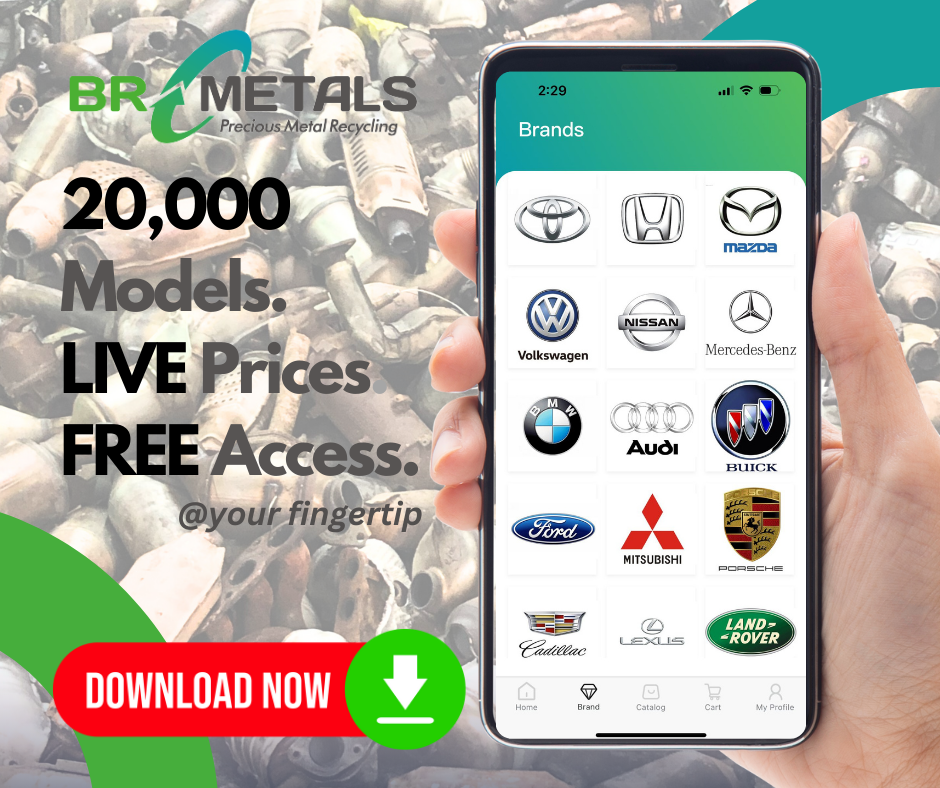
Catalytic converter price apps can be helpful for quick reference. BR Metals offers a free catalytic converter price app for Singapore, Thailand, Vietnam, and Malaysia, providing pricing insights and helping sellers understand market movements.
However, for bulk sellers, app-based prices should be treated as a reference point rather than the final word. For qualifying bulk lots, actual sampling and assay can provide a more accurate basis for settlement.
Choose Assay-Based Settlement for Suitable Bulk Lots
If your lot is large enough, ask whether assay-based settlement is available. BR Metals’ Fast Track Settlement is indicated for smaller bulk lots from 200 kg to 500 kg of ceramic ash or at least 600 pieces of uncut catalytic converters, while Payment Upon Analysis is recommended for bigger lots of 500 kg of ceramic ash and above.
These thresholds help sellers decide when to move from per-piece selling to a more analytical recycling model.
Ask About Hedging
Because platinum, palladium and rhodium prices fluctuate, bulk sellers should ask how the buyer manages metal price risk.
BR Metals states that it can hedge the platinum, palladium, and rhodium recovered from customer material under its Payment Upon Analysis model.
For sellers moving high-value lots, this can help reduce exposure to sudden market swings.
Build a Long-Term Relationship with a Reliable Recycler
For repeat bulk sellers, the goal should not be a one-off transaction. A strong recycling partner can help with pricing transparency, technical support, documentation, cash-flow planning, and long-term business growth.
BR Metals positions its recycling service around transparency, professionalism, personal customer care, and long-term partnerships.
In a competitive market, those factors can matter as much as the quoted price.
Why Bulk Sellers Work with BR Metals
BR Metals is a specialist in precious metals recycling and one of Asia’s major processors of end-of-life spent catalytic converters. The company recovers platinum, palladium, rhodium, gold, and silver, and serves customers across Singapore, Malaysia, Thailand, Vietnam, and other markets.
For bulk catalytic converter sellers, BR Metals offers:
- Direct Purchase and Value-Based Settlement options
- In-house sampling and assay capabilities
- XRF and ICP analysis for precious metal content
- Advance payment options for qualifying lots
- Hedging support for platinum, palladium, and rhodium
- Regional customer support across key Southeast Asian markets
- Transparent documentation from processing to settlement
Instead of simply asking, “Who buys catalytic converters near me?”, bulk sellers should ask a better question:
Which catalytic converter recycling company can help me unlock the true value of my material?
For sellers with the right volume, an assay-based recycling model can provide a more accurate, transparent, and commercially sustainable way to sell catalytic converters.
Ready to Sell Catalytic Converters in Bulk?
If you are a scrap dealer, workshop, dismantler, aggregator, or recycling business looking for companies that buy catalytic converters in Singapore, Malaysia, Thailand, or Vietnam, speak with BR Metals.
Whether you prefer direct purchase or value-based settlement, BR Metals can help you assess the best recycling model for your lot size, cash-flow needs, and business goals.
Contact BR Metals today to discuss your catalytic converter materials and find the most suitable recycling model for your business.
FAQ
Most of our buyers are automakers, chemical manufacturers, and precious metals traders.
Platinum Group Metals (PGM) recycling is the process of recovering platinum, palladium, and rhodium from spent materials like catalytic converters. This practice is essential because it:
- Reduces environmental impact by lowering the demand for raw mining.
- Supports sustainability through circular economy principles.
- Secures a secondary supply of critical metals for the automotive, electronic, and chemical sectors.
Yes. we buy directly from industrial sellers, including scrap yards, automotive workshops, and vehicle dismantlers. To ensure fair market value, our companies typically process, sample, and laboratory-test the material to determine its exact precious metal value and content before finalising the payout.
For bulk sellers, assay-based settlement is generally the superior choice.
- Per-piece sales offer immediate, cash-in-hand transactions but rely on broad price estimates.
- Assay-based recycling uses precise chemical analysis to pay you for the actual metal content, yielding higher and far more transparent returns on large volumes.
To maximise your profitability, partner with reputable buyers who offer a transparent, data-driven process. Look for facilities that provide:
- Advanced testing methodologies (such as XRF and ICP analysis).
- Documented, reliable sampling procedures.
- Clear, upfront settlement terms and flexible payment structures.